Coronary Calcium Score — The Scan I Regret Getting
I thought My Heart Was Fine. My Arteries Disagreed.

Heart disease is the number one killer globally, and for most of my life I assumed it wasn’t really my problem. I’d always been active, my blood pressure was excellent, and an EKG at 40 came back clean. Cancer runs in my family, not heart disease. The one outlier I’d been conveniently ignoring was an elevated LDL that had probably been creeping up for years — but I’d talked myself into believing it was fine because everything else looked good.
That’s called being metabolically healthy and spectacularly wrong.
As part of my longevity deep dive I’d been reading about more advanced cardiovascular testing — ApoB, Lp(a), particle counts — and a test called a coronary artery calcium scan, or CAC. The Wall Street Journal described it recently as “a simple computed tomography (CT) scan of the heart that takes less than 10 minutes” that checks for calcium deposits as a proxy for plaque buildup. Low cost, non-invasive, and increasingly recommended as a far better predictor of cardiovascular risk than a standard cholesterol panel.
I brought it up with Dr. Alejandra at our first appointment in Todos Santos this spring. She agreed on the approach, wrote the orders, and recommended a clinic in Cabo San Lucas. We appointments within a week and paid 7,000 pesos — about $350 USD. This compares well to the $400–800 you’d typically pay out of pocket in the US. As promised, it was quick and painless. Bonus: the clinic is near the Cabo Costco, so we made a day of it. Sadly, in the spirit of the whole longevity project, I had to walk past the food court offerings of cheap hot dogs, pizza slices, and churros without stopping. Progress has a cost.
I went in expecting good news. Over the past nine months I’d lost nearly 25 pounds, my estimated VO2 max had climbed to around 51, my resting heart rate was averaging 53 bpm, and my blood pressure was tracking at a consistent 107/69. I felt better than I had in years. The scan was going to confirm what I already believed — that the lifestyle changes were working and my heart was in good shape.
The results came back by email a few days later. My score was 332.
For context: a score of zero means no detectable calcium. Anything above 300 is considered high risk. The MESA calculator — the standard tool cardiologists use to put your score in age and sex context — placed me at the 95th percentile for men my age. One way to think about it: the calcium in my arteries reflects decades of plaque buildup, accumulated well before I started paying attention. The lifestyle changes don’t erase the past. They just change what happens next.
My wife while thin is not much of an exerciser and was pessimistic about the prospects of her testing. Thankfully her score came back with a zero.
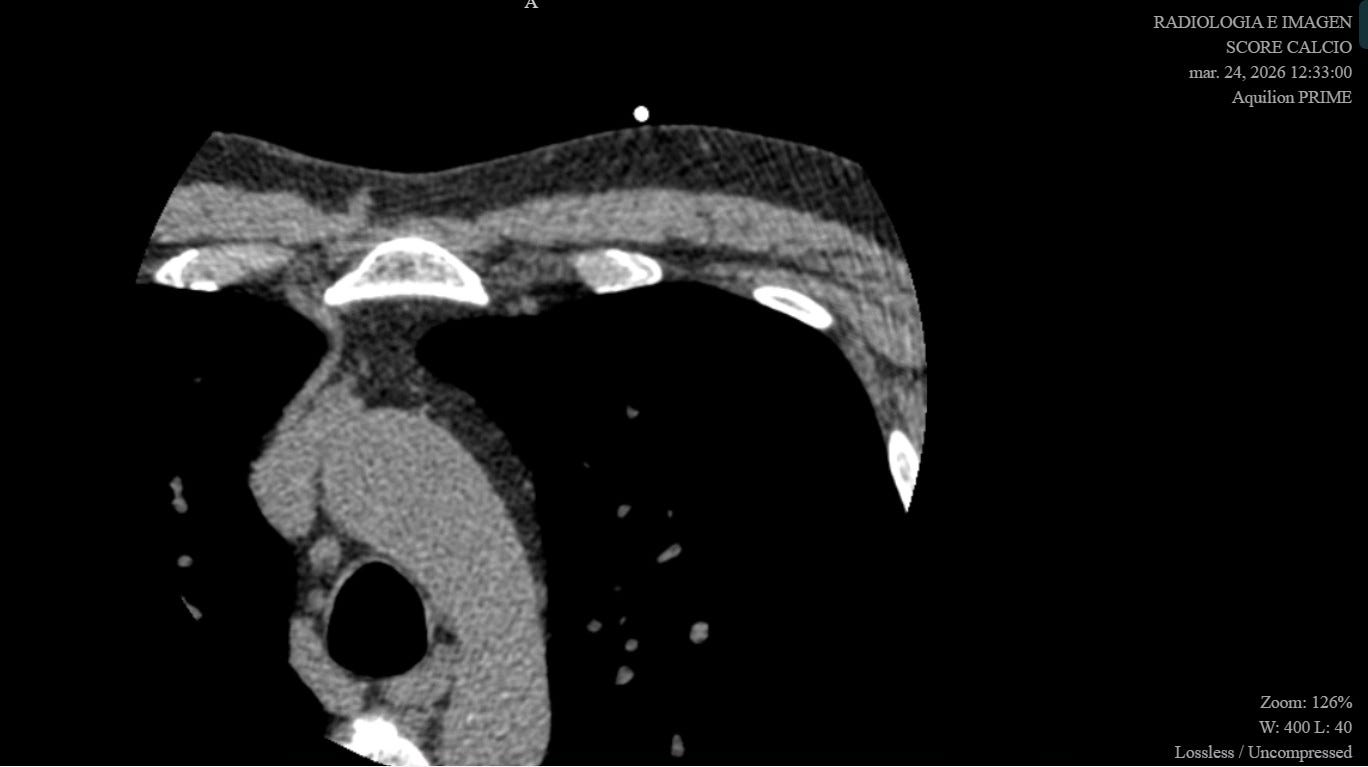
After the initial shock I started researching hard. The immediate decision was straightforward: it was time to stop being hesitant about statins. I’d been resistant for years — the usual concerns about side effects, skepticism about long-term use — but a 332 CAC score has a way of clarifying your thinking. Dr. Alejandra wrote the prescription and I started Rosuvastatin that week. I’m also on Ezetimibe, which blocks cholesterol absorption in the gut and works synergistically with the statin.
On the supplement side I tightened up my stack with cardiovascular risk specifically in mind — omega-3s (my FADS2 genetic variant makes this especially relevant, as I wrote about in a previous post), Vitamin K2 to direct calcium away from arterial walls, CoQ10 for statin support, and Berberine as a complementary metabolic intervention.
So why do I regret the scan?
I don’t regret knowing the number. I regret not getting a better test.
The CAC scan tells you about the past. Calcium is the body’s response to soft plaque — essentially scar tissue. A high score means plaque built up and at some point the body calcified it. What the CAC scan cannot tell you is what’s happening right now: whether there’s active soft plaque that hasn’t calcified yet, how much of your arterial wall is affected, or whether any blockages are forming.
The test that answers those questions is a Coronary CT Angiography, or CCTA. It uses contrast dye to image the arteries directly and gives a far more complete picture of what’s actually going on. A newer AI-enhanced analysis — available through companies like Cleerly — can characterize plaque type and estimate risk with a level of detail that wasn’t possible even a few years ago. That AI component isn’t yet available in Mexico, which is partly why I didn’t start there.
CCTA runs $250–$1,000 or more out of pocket in the US. There are also legitimate questions about repeating radiation-heavy scans in a short window, which is worth discussing with your doctor. But knowing what I know now I would have paid it and started there. Worth noting too: a zero CAC score like my wife’s is not a guarantee of clean arteries — soft plaque that hasn’t calcified yet won’t show up on a CAC scan at all.
Getting the CCTA with AI analysis is on my list. I’ll write about that when I do it.
What’s actually changed
The labs tell a more encouraging story. Before starting the protocol in March 2026, my LDL was running elevated and my ApoB was 93 mg/dL. By May 5 — just 40 days into Rosuvastatin and dietary changes — my LDL had dropped to 46.6 mg/dL, well below the target of 70. HDL came in at 59, hs-CRP at 0.90 mg/L. Dr. Alejandra called the LDL response impressive. My 10-year coronary heart disease risk, which had been calculated at 8.3% before the statin, is now estimated around 5.5% — and trending lower as the protocol matures.
On the exercise side I’ve added Norwegian 4x4 intervals twice a week — four minutes at near-maximum effort, four minutes recovery, repeated four times. The research behind this protocol is solid, with significant VO2 max improvements demonstrated in multiple trials, and VO2 max is one of the strongest independent predictors of long-term cardiovascular health and all-cause mortality. Combined with resistance training and daily walking, it’s a routine I can actually sustain in Baja.
The CAC score doesn’t go down. That number is permanent. But the goal now is to slow progression, reduce inflammation, and make sure the next chapter of the story looks different from the last one.
That’s what Medicine 3.0 looks like in practice — not a clean bill of health, but better data and a plan.