Help me Rhonda... with genetic testing
What Dr. Rhonda Patrick's genetic report actually tells you (and what it doesn't)

My wife and I have been curious about genetic testing to learn more about our health risk factors. I have a family history of cancer with my mother’s father dying of colon cancer (get your colonoscopy the drugs are awesome!). My wife’s mother died too soon from dementia with a rapid decline in her last years.
I thought maybe I had found a hack for testing at Dr. Rhonda Patrick’s Found My Fitness website for the low price of $25 for a comprehensive report. The hook - “Got your 23andMe or Ancestry.com DNA data? Upload your DNA data and in less than 5 minutes you’ll discover the most impactful genes—and what research suggests may be the most impactful nutritional and lifestyle insights specific to those genotypes. “
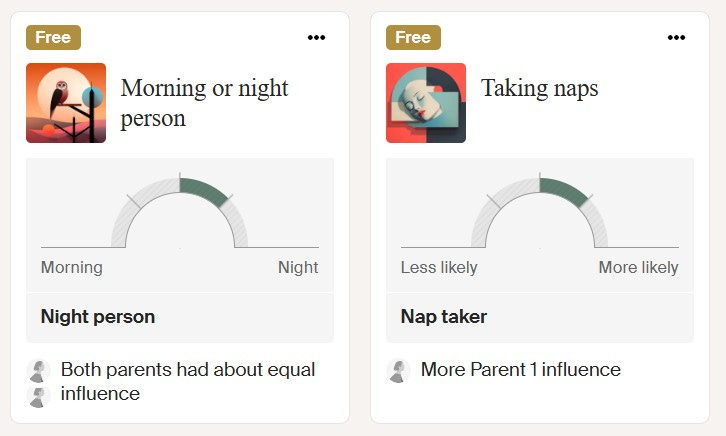
Always down with a discount we found that the Mexico Ancestry site might be cheaper than the US and was running a promotion. With the assurance from Found My Fitness that Ancestry was fully supported and “you only need to get the basic ancestry service in order to request the FoundMyFitness genetic report” we ordered our DNA kits. While Mexico is a modern country and deliveries are not made by donkey it can sometimes feel like that. After a wait of a couple of months, we were able to get our results on Ancestry.com. The DNA section of their website is pretty useless as they showed me a large section of Europe where my people are from and gave me some basic traits based on my DNA that I was a night person and more likely to take naps. Totally explains why I like to be in bed reading by 9pm and haven’t taken a serious nap since I was in college and the first George Bush was in office.
With some quick instructions I was able to successfully download my raw DNA text file and upload to Found My Fitness.
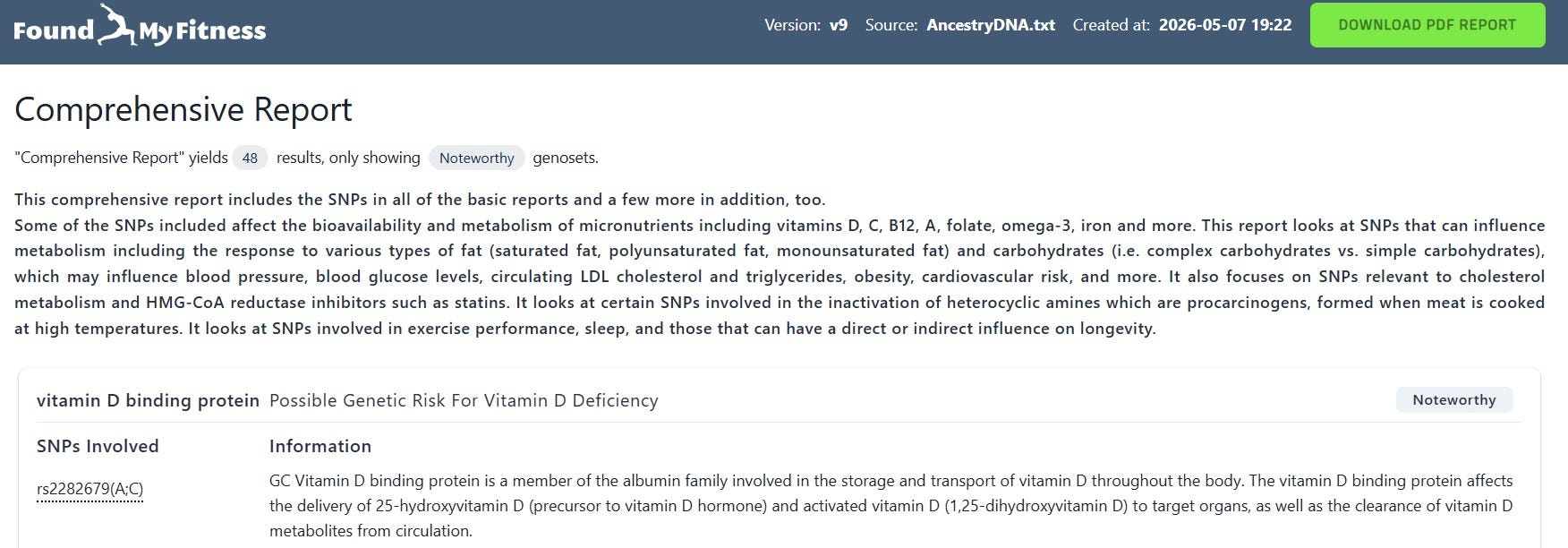
The report came back in minutes — 88 genetic markers called “genosets,” each one linking a specific gene variant to a research finding with lifestyle or nutrition implications. The interface labels everything as either “Noteworthy” or “Less Noteworthy”. Noteworthy basically just means worth paying attention to, not necessarily bad news. First tip: don’t panic when you see your name next to words like “increased risk.” Read the whole card.
**The good stuff**
Some findings were genuinely useful and immediately actionable. The one that hit hardest was FADS2 — a variant that means I convert plant-based omega-3s (the kind in flaxseed and chia) into the usable EPA form about 27% less efficiently than average. I’d been taking fish oil somewhat casually. Now I’m not. If you eat a plant-based diet and have this variant, you may be getting far less omega-3 benefit than you think.
I also got a clean sweep on statin pharmacogenomics — three separate genes (HMGCR, SLCO1B1, COQ2) all indicating normal response and normal side effect risk. This turned out to matter more than I expected when my doctor started that conversation, and it was genuinely reassuring to have the genetic picture already in hand.
On the longevity side, two FOXO3 variants, SIRT1, and TP53 all came back favorably. I’m not popping champagne — good genetics don’t override lifestyle and they certainly don’t show up on a CT scan — but it’s nice to know the blueprint has some solid sections.
**The limitations — and they matter**
Here’s where I have to be honest about what we didn’t get, because it goes to the heart of why we bought the kits in the first place.
My wife’s mother died of dementia. That’s not an abstraction for us. APOE — the gene most strongly associated with Alzheimer’s risk, the one Rhonda Patrick has talked about extensively on her podcast — is not in this report. Not flagged, not limited, just absent. It turns out AncestryDNA doesn’t reliably genotype the two SNPs that determine APOE status. Found My Fitness knows this and the report simply skips it. For anyone coming to this report specifically to understand cognitive risk, that’s a significant gap that isn’t clearly communicated upfront.
Beyond APOE, the report lists more than 60 additional gene variants it couldn’t assess because the AncestryDNA raw data didn’t cover them — including PCSK9 and LPA, both directly relevant to cardiovascular risk. You don’t know what you don’t know, and the report doesn’t exactly wave a flag about it.
There’s also a section covering COVID-19 susceptibility genes that reads like a time capsule from 2021. The science has moved considerably since those early pandemic studies and some of those findings haven’t held up. It’s a minor thing but it dates the report in a way that undermines confidence in the newer findings.
**So is it worth $25?**
For me, yes — with caveats. The report works best as a hypothesis generator and a supplement personalizer. I found specific, actionable reasons to prioritize certain nutrients based on my actual genetics rather than general recommendations. That has real value.
But if you’re going in hoping to get a complete picture of your Alzheimer’s or cardiovascular genetic risk, you’ll come out with an incomplete answer and you may not realize it. For APOE specifically, a simple blood test your doctor can order will tell you what $25 and a vial of saliva cannot.
One last thing: if you’re going to do this, get your actual labs done too. Genetics tell you about tendencies and probabilities. A blood test tells you what’s actually happening. The most interesting conversations happen when those two pictures are sitting side by side — and sometimes they tell very different stories. I will cover our experience using Function Health and labs down in Baja, Mexico in the next article. Subscribe to follow along.