Notes on Longevity Levers: A Series
What I think moves the needle from large to small and unknown

A reminder of who’s talking: a curious non-expert trying to make sense of the evidence on longevity. No medical background. No agenda. Just a guy with a spreadsheet problem and a coronary calcium score that got his attention.
Over the past year I’ve gone fairly deep on this stuff — the labs, the protocols, the watch on my wrist at 3am quietly judging my REM sleep. Along the way I’ve built up a set of personal notes on what seems to move the needle, organized from large to small to unknown.
That ordering is the whole point of this series, so let me say it plainly.
The big levers are boring and free. Exercise. Sleep. Food. They have mountains of evidence behind them, they’re available to everyone, and nobody wants to hear about them because there’s nothing to buy. The small levers are the supplements and gadgets and optimizations — the stuff that fills podcasts and empties wallets. Some of it helps at the margins. Some of it is a bet. And some of it is, charitably, unknown.
The longevity world has a way of getting this exactly backwards. People will debate magnesium forms in internet comment sections for hours while sleeping five hours a night. I’ve been that guy. I’m trying not to be that guy anymore. This series is partly a record of that effort.
So here’s the plan. Six posts, one lever at a time:
Part 1 — The Stack. What I swallow every day and why, sorted honestly into “proven,” “plausible bet,” and “mostly habit.” (Yes, I’m starting with the smallest lever. It’s the one everybody asks about. We might as well get it out of the way so we can talk about the things that matter.)
Part 2 — Measurement. The labs, the DEXA scan, the body composition scale, the watch, the home blood pressure cuff, and the slightly unhinged spreadsheet that ties it together. You can’t manage what you don’t measure — but you can definitely over-measure what doesn’t matter.
Part 3 — Exercise. The biggest lever there is. VO2 max, zone 2, the brutal Norwegian 4x4 protocol I do on an air bike that I have complicated feelings about, and the minimum effective dose of lifting heavy things.
Part 4 — Sleep. The lever I ignored for fifty years. Consistent bed times, cool dark rooms, morning sun, and what my heart rate variability has to say about that second margarita.
Part 5 — Nutrition. The most controversial one, which is funny, because the parts everyone agrees on would get most people 90% of the way there. What we actually eat down here in Baja, my morning shake (a 44-gram-protein, 31-gram-fiber concoction I will defend with my life), and why I refuse to join a dietary religion.
These are my personal notes, not a program. My situation is not your situation — a lot of what I do is shaped by my specific numbers, my genetics, and my doctor. What I can offer is the reasoning: why each thing earned its place, what the evidence looks like, and where I’m honestly just guessing.
Feel free to let me know if you agree, disagree, or have levers I should consider. Disagreement is genuinely welcome. It’s how half of this stack got built and how the other half will eventually get thrown out.
Part 1 is up next. Bring coffee.
The Stack, Part 1: Or, What I Swallow Every Day and Why
Now we descend into the weeds: supplements. The smaller, the unproven, the maybe.
So let’s talk about my supplement cabinet.
It’s gotten out of hand. I’ll just say that up front. I started a couple years ago with fish oil and a multivitamin, like a normal person. Today I take something like seventeen distinct things across the day, sorted into morning and evening piles like a tiny, sad pharmacy. My wife Jaime has opinions about this. The opinions are mostly correct.
Here’s the thing I want you to understand before we go item by item: most of this is not proven to extend your life. Some of it has decent evidence behind it. Some of it is a bet. A couple of items I take mostly because the downside is low and the upside is plausible, which is a very different statement than “this works.” I try to be honest with myself about which bucket each thing falls in, and I’ll be honest with you too.
I have run this by Dr. Alejandra, my integrative-medicine physician in Todos Santos, and the heavy hitters — the statin especially — are prescription decisions made with actual lab data in front of us. She prescribed The supplements are the part I have more latitude on, but even there she knows what I’m taking. That matters. A pile of capsules this big interacts with itself in ways one curious non-expert cannot reliably predict.
One more frame before we start. My situation is not your situation. I have a coronary artery calcium score of 332. For the uninitiated, that’s not a great number — it means I’ve got meaningful calcified plaque in my heart’s arteries, and it reframes basically every decision I make about cardiovascular risk. A lot of what’s in this stack is there because of that number. If your arteries are clean, you do not need to be eating nattokinase. Please do not copy my cabinet. Copy my approach to thinking about it, maybe. Not the cabinet.
Okay. Let’s open the doors.
The one that actually matters: the statin
Rosuvastatin 10mg + Ezetimibe 10mg, combo tablet, taken in the evening.
This is not a supplement and I’m putting it first anyway, because everything else in the cabinet is a footnote to it. With a CAC of 332, getting my ApoB — the particle count that actually drives plaque, the number Peter Attia won’t shut up about and is right not to — down and keeping it down is the whole ballgame. The statin lowers how much cholesterol my liver makes. The ezetimibe blocks how much my gut absorbs. Two doors, both shut.
I recently came down from 20mg of rosuvastatin to 10mg combined with the ezetimibe, on Dr. Alejandra’s guidance. Why drop the dose? Because the combo gets me to the same place with less of a single drug, and my last labs were, frankly, excellent — ApoB came back at 43. For context, “optimal” in the aggressive-prevention world is under 60, and a lot of guidelines are happy with under 90. So 43 is the kind of number that makes you want to frame the lab report.
If you take one thing from this entire article it’s this: for cardiovascular risk, the prescription tools are the levers that work, and the supplements are mostly trying to help around the edges. Don’t let a beautiful pile of capsules distract you from the boring pharmaceutical that’s doing the actual heavy lifting.
Statin support and cardiac energy
CoQ10 (Ubiquinol) 100mg × 2 — 200mg/day, morning and evening.
Statins can deplete CoQ10, which your mitochondria use to make energy, and some people get muscle aches that the CoQ10 may help with. The evidence that it prevents statin muscle pain is genuinely mixed — studies go both ways. I take it because I’m on a statin for life, the ubiquinol form absorbs well, and the downside is essentially zero. This is a “low downside, plausible upside” pick. I’m not going to pretend it’s settled science. This one and the fish oil were actually prescribed by Dr. A.
The omega-3 situation
Omega-3, Metagenics OmegaGenics EPA-DHA 1000 — 710mg EPA + 290mg DHA, morning with food.
This is the supplement I’m most confident about, partly because of my genetics. My FoundMyFitness report flagged a FADS2 variant, which in plain English means my body is bad at converting plant-based omega-3s (the ALA in flax and chia) into the EPA and DHA that actually do the work. For me, direct supplementation isn’t optional — it’s the only reliable way to get there. Some people can rely on conversion. I am not one of them. Genetics earns its place in these decisions.
I went through a Nordic Naturals phase, then switched to the Metagenics, which Dr. A put me onto. I recently ran out and need to resume — a confession, not a recommendation. The molecular form and the actual EPA/DHA content matter way more than the big number on the front of the bottle, which is mostly filler oil. Dr. A took the the time to show me a comparison during one of our first visits. I have also read that if you get the fish burps from your pills, they are probably rancid. I keep them in the fridge now and have no issues.
The cardiovascular experiments
This is the section where the curious non-expert really shows his whole personality. Everything here is aimed at one target: the plaque in my arteries. And everything here ranges from “decent evidence” to “interesting bet.”
Kyolic Aged Garlic Extract — 4 tabs/day, ~1,200mg, with meals. This one I actually like the evidence on. The FAITH trial and related work suggest aged garlic extract may slow the progression of coronary plaque, and 1,200mg is roughly the trial dose. Garlic supplement studies are not exactly funded like cancer drug trials, so the evidence base is thinner than I’d like, but for something this benign with a real (if modest) signal, I’m in.
Citrus Bergamot 600mg × 2 — 1,200mg/day, before meals. Bergamot polyphenols have some data for nudging LDL, ApoB, and triglycerides down and HDL up. Modest effects, decent enough small studies. A hedge that stacks with everything else aimed at the same number.
Berberine HCL 500mg × 2 — 1,000mg/day, morning and evening. Sometimes called “nature’s metformin.” Reasonable evidence for glucose, lipids, and ApoB. It also reduces cholesterol absorption in the gut, which means it’s additive with the ezetimibe and the beta sitosterol — three things shutting the same door. This one I’d put in the “decent evidence” bucket, not the “wild bet” bucket.
TUDCA 250mg × 2 — 500mg/day, with food. Here we drift toward the speculative end. TUDCA is a bile acid with interesting data on cellular and vascular inflammation, but the human cardiovascular evidence is early. I’m taking it as a bet, and I’m telling you it’s a bet.
Nattokinase 8,000 FU/day — with food. And here we are at the deep end of the pool. Nattokinase is an enzyme from fermented soybeans with some — some — research suggesting it may help with plaque. The evidence is preliminary and I hold it loosely. If you’d told 2010 me that I’d one day be eating a Japanese fermented-soybean enzyme to manage heart plaque, I’d have asked what went wrong in my life. Nothing went wrong. I just got a CAC score and a reading habit.
If your reaction to this paragraph is “that seems like a lot of unproven stuff aimed at one number,” you are reading it correctly. That’s the honest assessment. With a CAC of 332, I’ve decided I’m willing to make some low-risk bets in the same direction as the proven tools, while keeping the proven tools doing the real work. You might decide differently. You’d have a good case.
The cholesterol-absorption corner
Beta Sitosterol 500mg — 2 softgels/day, with food. A plant sterol that blocks cholesterol absorption (additive with ezetimibe and berberine, as mentioned) and, separately, helps with urinary flow — relevant to me for reasons I’ll get into in a future post involving a prostate the approximate size of a small citrus fruit. Two birds.
The fiber
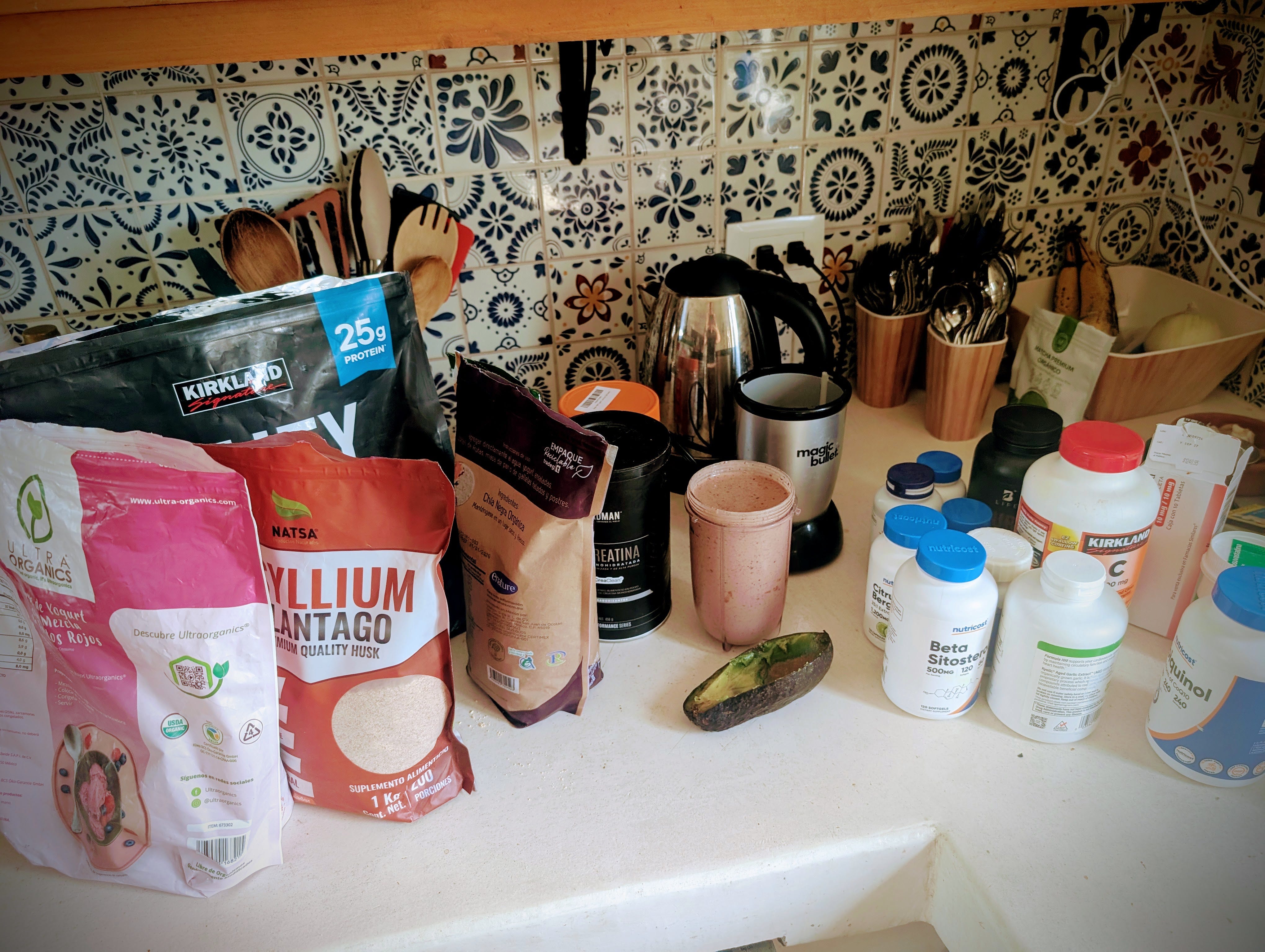
Psyllium husk 5g × 2–3/day, with water. Boring. Effective. Soluble fiber genuinely lowers LDL by 5–10% and feeds the gut microbiome, and it costs about nothing. The 5 grams of husk is roughly 4 grams of actual soluble fiber. I take a scoop with my morning shake and usually another with lunch. Of everything in this article, this is among the best-evidenced and least glamorous. That ratio tells you something about supplements in general. The exciting ones are usually exciting because we don’t actually know if they work.
The psyllium doesn’t work alone, either — it rides in on the back of my morning shake, which is its own little fiber delivery vehicle. The relevant cargo:
2 tablespoons chia seeds — ~10g fiber. The big contributor, mostly soluble, and the reason the shake turns to pudding if you don’t drink it fast enough.
2 tablespoons flax — ~5g fiber. Soluble fiber plus a little plant-based omega-3 that, per the FADS2 problem above, my body mostly can’t use — but the fiber counts.
1 tablespoon green banana flour — ~4g resistant starch. Technically a different beast than fiber, but it behaves like one: it skips digestion in the small intestine and gets fermented by your gut bugs down in the colon, which is exactly what you want.
Add the psyllium scoop and the morning shake alone is delivering somewhere around 23 grams of fiber and resistant starch before I’ve eaten an actual vegetable. The seeds and the banana flour are food, not supplements, so I won’t pretend they belong on a stack list — but functionally they’re doing the same job, and they’re a big part of why I don’t take fiber especially seriously as a pill problem. Eat the seeds. Drink the husk. Move on.
A warning I deliver with feeling: do not go from zero to 20-plus grams of fiber in a single morning. Start low, work up, and your gut will forgive you. Skip this advice and you’ll learn — vividly, and on your own schedule — why I’m giving it.
The body-maintenance basics
Creatine 10g/day, any time. Not just for gym bros. Strong evidence for preserving lean muscle, increasingly interesting evidence for cognition. As a 58-year-old who’d very much like to keep his muscle and his marbles, this is a near-automatic pick. One of the highest evidence-to-hype ratios on the list.
Glycine 3g before bed. Lowers core body temperature slightly, which helps sleep onset and slow-wave sleep. Also a substrate for collagen and glutathione. I take it for sleep, mostly, and the sleep data is real enough.
Magnesium glycinate, PM. Sleep quality, HRV support, cofactor for a few hundred enzymes. Most people run a little low. The glycinate form absorbs well and doesn’t send you running to the bathroom like some other forms. Easy yes.
The boring insurance
Centrum Silver +50, daily. A mass-market multivitamin. Insurance against gaps, nothing more. I don’t expect it to extend my life. I expect it to cover the days my diet isn’t perfect.
Vitamin C 1,000mg × 2 — 2,000mg/day. Kirkland, with rose hips and bioflavonoids. Honestly closer to habit than conviction. The high-dose vitamin C longevity story is not strong. I keep it in the cabinet and hold no illusions.
Vitamin D3 1,000 IU + K2 45mcg (MK-4) — 2 caps/day, 2,000 IU D3 + 90mcg K2. The D3 keeps my levels in range. The K2 is the interesting part: it helps route calcium into bone and away from arteries, which, given the 332, is exactly where I’d like my calcium to go. This pairing replaced an older D3-plus-curcumin-and-ginger product. Bone support and arterial-calcification logic in one capsule.
So what’s the actual takeaway
Here’s where I land after laying it all out.
The statin is doing the real work. The omega-3 has genetics on its side and earns its place. Creatine, psyllium, magnesium, and D3/K2 are well-evidenced, low-risk, and I take them without much hand-wringing. The big cardiovascular pile — garlic, bergamot, berberine, TUDCA, nattokinase — is a stack of bets, some better than others, all pointed at the one number that scares me, all taken with my doctor’s knowledge and a clear understanding that I might be wrong about half of them.
And several items are honestly just there because the downside is low and quitting feels like more effort than continuing. That’s not a great reason. It’s the real reason for more of these than I’d like to admit. If I were starting over, the cabinet would be smaller.
If you take nothing else from this: spend your effort on the levers that work — the exercise, the sleep, the food, and if your numbers call for it, the prescription that your doctor and your labs actually justify. Then, if you want, make a few small low-risk bets at the margins and be honest with yourself about which ones are bets.
The supplements are the seasoning. They are not the meal.
Next time in the series: measurement and tracking — the labs, the scale, the watch, the home blood pressure monitor, and the slightly unhinged spreadsheet that holds it all together. Bring more coffee.
References and rabbit holes
In the spirit of showing my work — here’s some of the research behind the claims above. I’ve tried to be honest about what’s strong, what’s mixed, and what’s barely a whisper. Read it yourself and draw your own conclusions; that’s the whole point of “open source.”
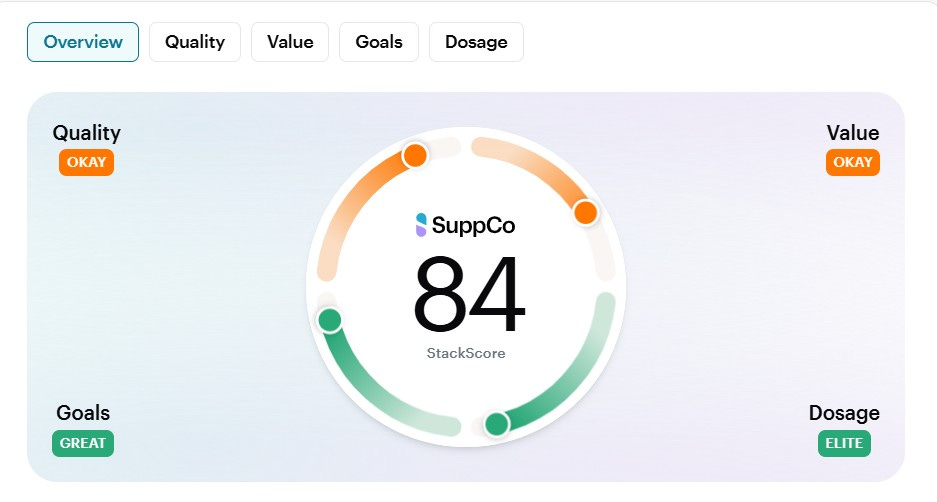
First, a caveat that comes before all the studies: is it even in the bottle? This matters more than any single trial below, so I'm putting it up top. Supplements are, for the most part, completely unregulated. In the US the FDA doesn't verify that what's on the label is what's actually in the capsule before it goes on the shelf — they mostly show up after something's already gone wrong. So there are really two questions, not one. Does the ingredient have evidence? (That's everything below.) And does this specific bottle contain a useful, uncontaminated dose of it? (That's a totally separate problem, and it's on you to solve.) I solve it two ways. I pay for a ConsumerLab subscription, which independently tests and analyzes actual products on the shelf — worth the money to me, given how many capsules I'm swallowing. And there's a free option, Suppco, which will rate your stack; for the curious, here's the rating it gave mine. Neither is scripture, but both beat trusting the label and the guy on the podcast.
Aged garlic extract (the FAITH trial and friends.)
FAITH randomized trial (AGE + CoQ10, vascular function): https://www.sciencedirect.com/science/article/abs/pii/S0899900712001402
AGE reduces low-attenuation plaque in metabolic syndrome (J Nutr): https://jn.nutrition.org/article/S0022-3166(23)00525-4/fulltext
AGE and the atherosclerotic process, European cohort (PMC): https://www.ncbi.nlm.nih.gov/pmc/articles/PMC7191741/
CoQ10. The cleanest cardiovascular data I have for it is bundled into that same FAITH trial above (AGE + CoQ10 together). The evidence that CoQ10 actually prevents statin muscle pain is genuinely mixed — trials go both ways — so I take it as a low-downside hedge, not a sure thing.
Omega-3 and my FADS2 variant. The reason I supplement directly rather than relying on flax and chia is personal genetics, flagged in my FoundMyFitness report — a FADS2 variant that makes me a poor converter of plant ALA into the EPA and DHA that do the work. That’s a “me” fact, not a universal one. If you want the general background, FADS gene variants and omega-3 conversion efficiency are well documented in the nutrigenomics literature.
Citrus bergamot. Decent small-trial evidence for nudging LDL, total cholesterol, and triglycerides down.
Randomized placebo-controlled trial, standardized bergamot flavonoids (Foods, 2024): https://www.mdpi.com/2304-8158/13/23/3883
Systematic review / meta-analysis of bergamot on lipids: https://www.ncbi.nlm.nih.gov/pmc/articles/PMC11641072/
Berberine. This one’s in the “decent evidence” bucket — meta-analyses consistently show reductions in glucose, LDL, total cholesterol, and triglycerides.
Efficacy/safety meta-analysis of 17 double-blind trials (Cardiology Discovery): https://mednexus.org/doi/10.1097/CD9.0000000000000087
Berberine in type 2 diabetes, 46-trial meta-analysis (PMC): https://www.ncbi.nlm.nih.gov/pmc/articles/PMC8696197/
Nattokinase — and here’s where I keep myself honest. There’s a much-cited 1,062-person study reporting big plaque reductions at high doses (10,800 FU/day). But it was retrospective, not a randomized trial — and the one rigorous randomized imaging trial (NAPS, Hodis et al., 2021) found nattokinase did not slow carotid plaque progression versus placebo over three years. So the headline number comes from the weaker study design, and the stronger design was negative. I take it anyway, at a lower dose, as a low-stakes bet — but you should know the best evidence is unimpressive. That’s the honest version.
Positive retrospective study, 1,062 participants (Frontiers): https://www.frontiersin.org/journals/cardiovascular-medicine/articles/10.3389/fcvm.2022.964977/full
The negative randomized trial worth knowing about (NAPS, discussed): https://blueripple.com/natto/natto-atherosclerosis/
TUDCA. This is the speculative end. The bile-acid/vascular-inflammation story is mostly mechanistic and preclinical — I’m not aware of strong human cardiovascular outcome data, which is exactly why I call it a bet. If you find good human trials, send them my way.
Beta sitosterol. Two separate stories: plant sterols reduce cholesterol absorption in the gut, and beta sitosterol has older randomized trials supporting improved urinary flow in BPH (the classic Berges work in the 1990s). It doesn’t shrink the prostate; it improves the mechanics.
Psyllium. One of the best-evidenced and most boring things in the cabinet. Meta-analyses confirm meaningful LDL reduction — and, relevant to me, reductions in non-HDL cholesterol and apoB too.
Psyllium and LDL/non-HDL/apoB meta-analysis (AJCN): https://ajcn.nutrition.org/article/S0002-9165(22)03007-6/fulltext
Earlier 8-trial meta-analysis (PubMed): https://pubmed.ncbi.nlm.nih.gov/10648260/
Creatine. High evidence-to-hype ratio. Strong for lean mass and strength when paired with resistance training, and a moderate-certainty signal for memory.
Cognition meta-analysis, 16 RCTs (PMC): https://www.ncbi.nlm.nih.gov/pmc/articles/PMC11275561/
Creatine in older adults — muscle, bone, cognition review: https://www.ncbi.nlm.nih.gov/pmc/articles/PMC12272710/
Vitamin K2 — and a caveat on my own form. The arterial-calcification rationale is appealing but the human evidence is genuinely mixed: the well-known Knapen study showed improved arterial stiffness at 180µg/day, while a 2022 Circulation trial in men with high aortic-valve calcium found no significant slowing of vascular calcification. Worth noting that most of this research uses the MK-7 form, while my supplement is MK-4 — they behave differently in the body, so I’m partly extrapolating. A flag for myself as much as for you.
Knapen MK-7 arterial stiffness study (summary): https://www.nutraceuticalbusinessreview.com/news/article_page/Vitamin_K2_MK-7_and_Cardiovascular_Calcification/149814
K2 + D in aortic valve calcification, randomized trial (Circulation): https://www.ahajournals.org/doi/10.1161/CIRCULATIONAHA.121.057008
Glycine and magnesium glycinate. Both taken mainly for sleep. Glycine has small studies on lowering core body temperature and improving sleep quality; magnesium glycinate is well-tolerated and widely used for sleep and HRV support. Neither is a longevity miracle; both are low-risk and I sleep better, which is the lever that actually matters.
A note on how to read all this: a single study proves nothing, “statistically significant” is not the same as “meaningful,” and a retrospective study is not a randomized trial. I am a guy with a reading habit, not a cardiologist.
**Quick update on the aged garlic extract.**
I watched an interesting Physionic video - https://www.youtube.com/watch?v=IlWuCN2o_fE -this morning with some more considerations on the benefits of AGE, and it surfaced newer data worth flagging — partly because it's interesting, and partly because it's a tidy lesson in reading this stuff with one eyebrow raised.
The one that got my attention: a [2025 trial (Ried et al.)](https://pmc.ncbi.nlm.nih.gov/articles/PMC11904864/) put middle-aged recreational endurance athletes on Kyolic AGE for twelve weeks. The AGE group improved VO2max, aerobic power, and lactate threshold — and, the part I actually care about, their pulse wave velocity dropped, meaning stiff arteries got more flexible. Given my CAC score and the fact that I'm still dragging myself through Norwegian 4x4 intervals on the air bike, "a supplement that nudges both VO2max and arterial flexibility" is squarely in my wheelhouse.
Then there's a brand-new [*Cell Metabolism* paper (Suzuki et al., 2026)](https://www.cell.com/cell-metabolism/fulltext/S1550-4131(26)00144-0) on the mechanism. A garlic compound called S1PC activates an enzyme (LKB1) that kicks off a cascade getting fat tissue to secrete eNAMPT, which travels to the brain and helps prop up muscle function. Genuinely cool fat-to-brain-to-muscle wiring. Big caveat the headlines skip: the actual muscle-strength and frailty improvements were in aged *mice*. The human part was narrow — a single dose bumped circulating eNAMPT. So: promising mechanism, not "garlic reverses human aging."
There's also a [small 2016 study (Punduk)](https://ejbio.imedpub.com/aged-garlic-supplementation-improves-muscle-performanceproperties-in-untrained-male.php?aid=9654) showing better muscle output in untrained men — but it was six guys. A hint, not proof.
Now the part worth flagging, and the reason I always check: nearly every one of these shiny new AGE studies traces back to Wakunaga, the company that makes Kyolic. The athlete trial used their product and ran through their research orbit; the *Cell Metabolism* paper has Wakunaga employees among its authors and a patent attached. That doesn't make the findings wrong — but "the garlic company's research concludes garlic is great" is precisely the thing I'd want you to know before you got excited. Same standard I'd hold anyone else to.
Net: it stays in my low-downside/can't hurt, plausible-upside folder, nudged up a hair because the arterial-flexibility angle lines up with everything else I'm chasing. Not a wonder drug. A reasonable bet I was already making.
Anyone else out there using AGE?
We must be doing something right. Ex- marathoner with quintruple bypass 10 years ago on the same path as you. Love the article. SuppCo score of 85.